- Educator Community |
- Access My Courses |
- Bookmarks |
- Emona Telecoms-trainer 101 Lab Manual Pdf
- Emona Trainer Lab Manual User
- Emona 101 Trainer Lab Manual Solutions
- Emona Trainer Lab Manual Online
- Emona Trainer Lab Manual Pdf
by Emona Tims
The Communications Principles Lab Manual covers a broad range of introductory digital and analog telecommunications topics through a series of hands-on laboratory experiments. Each experiment supports the theoretical concepts introduced in a first course in modern telecommunications. In each experiment, the student is challenged to build, measure, and consider concepts using the Emona Communications Board and NI ELVIS III instrumentation.
Download Course
Translated Resources available in Resources Tab
By Emona Tims The Communications Principles Lab Manual covers a broad range of introductory digital and analog telecommunications topics through a series of hands-on laboratory experiments. Each experiment supports the theoretical concepts introduced in a first course in modern telecommunications. Emona Datex Lab Manual Volume LABORATORY MANUAL. The ETT-202 Laboratory Manual set (Vol.1, 2 & 3) provides a turn-key solution for the teacher and student alike. ETT-202 Laboratory Manual. It is specially written to guide students through hands-on experiments and help them grasp the fundamental concepts of telecommunications.
Instructor Resources available. Get Access
19 labs are currently available. Check back soon for more.
LEARNING OBJECTIVES
After completing the labs in this manual, students will have the ability to complete the following actions:
- Discuss the use of amplitude, frequency, and phase in transmitting information in a signal.
- Describe how the time and frequency domain expressions of a signal are related, and discuss how and why signals are shifted in frequency.
- Describe the differences between continuous signals and discrete time (sampled) signals.
- Explain the relationship between analog and digital signals in a communications context, as well as describe the use of Fourier analysis.
- Describe the concept of the transmission model of a communications system.
- Construct various communications systems from their fundamental blocks.
- Improvise solutions to be able to process signals using the available blocks.
- Create new signals and systems using LabVIEW code, both as a generator and receiver of signals.
COURSE ALIGNMENT
| Level | Undergraduate |
|---|
| Topic | Communications |
|---|
| Style | Laboratory |
|---|
| Prerequisite Skills | Introductory Circuits; Instrumentation |
|---|
INTRODUCTION TO THE EMONA COMMUNICATIONS BOARD
In this lab students will become familiar with the block diagrams and the modules on the EMONA Communication Board that are used for building communication systems. They will also learn how to use the various NI ELVIS III instruments to generate signals and take measurements. Students will connect various communication blocks and then investigate the signal characteristics.
MODELING EQUATIONS
The activities in this lab demonstrate to students that the output of all communications systems can be described mathematically with equations, and that these equations can be modeled with electronic circuit blocks. Students will investigate the addition of two Sine wave signals using the Add module on the Emona Communication Board. They will investigate the output characteristic when the two input signals are the same and when they are out of phase. They will calculate the output signals and then compare the theoretical calculation with the measured signals.
FFT AND SPECTRA
In this lab, students will investigate the frequency spectrum of common signals by using the FFT mode of the Oscilloscope and relate this to the signals in the time domain. By understanding the frequency domain characteristics of various signal types, we can further develop our ability to think in both the time AND frequency domain when considering signals. The two go hand in hand and it is essential for the engineer to be well versed in both.
AMPLITUDE MODULATION (AM)
In this lab, students will create an amplitude modulated signal from a variety of message sources, calculate the modulation index, and confirm the frequency spectrum of this signal type.
Emona Telecoms-trainer 101 Lab Manual Pdf
AMPLITUDE DEMODULATION
In this lab, students investigate two methods to recover an amplitude modulation (AM) signal in order to develop an understanding of the demodulation process in the time and frequency domain. First, students will generate an AM signal using data from a file, and then they will use the envelope detector method to recover the original message by connecting the AM signal to a rectifier and the low-pass filter module on the Emona Communication board. Next students will use the product detection method, which requires some understanding of mathematics to recover the original signal.
DOUBLE SIDEBAND MODULATION AND DEMODULATION (DSBSC)
In this lab, students will create a DSBSC signal and gain insight into the meaning of “Suppressed Carrier.” They will also use product demodulation to recover the message and examine the effect of phase and frequency errors on the recovery process.
SSB MODULATION AND DEMODULATION
In this experiment, students will generate an SSB signal by implementing the mathematical model for the phasing method. They will then use a product detector (with a stolen carrier) to recover the message.
FM MODULATION
In this lab, students will generate a frequency modulated signal using a variety of message sources. They will measure the power and bandwidth of this FM signal by viewing the signal in the time and frequency domains, and then calculate the frequency deviation of the modulator circuit.
FM DEMODULATION
In this lab, students construct a demodulation process that translates the frequency variations of a frequency modulated signal into voltage variation in a linear manner. Students will use the method of zero-crossing detection to translate between signal domains.

FSK
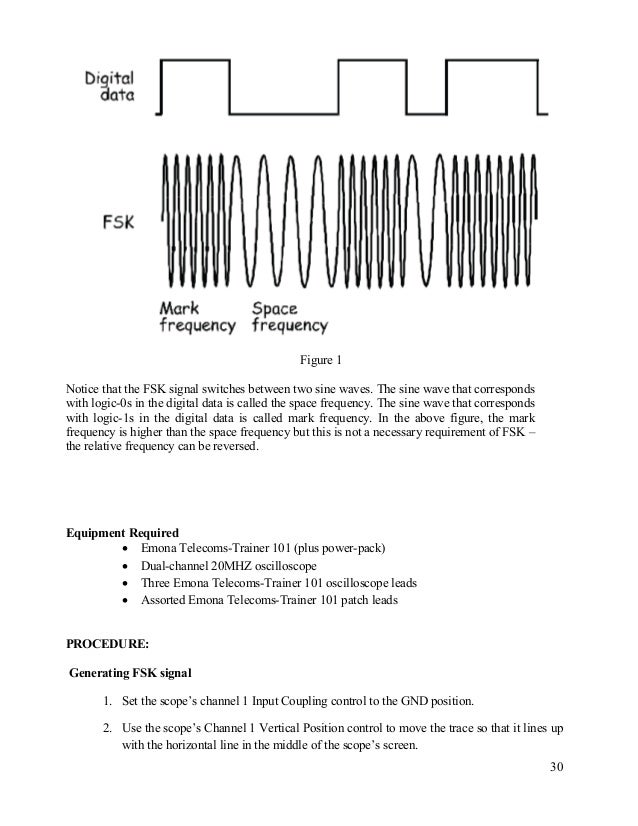
For this experiment students will implement the VCO method of generating an FSK signal and then recover the data by using a filter to pick-out one of the sinewaves in the FSK signal and demodulate it using an envelope detector. Finally, students will observe the demodulated FSK signal’s distortion and use a comparator to restore the data.
BINARY PHASE SHIFT KEYING (BPSK)
In this lab, students will generate a BPSK signal using a multiplier to implement its mathematical model and a sequence generator to model the message. They will recover the data using another multiplier module to implement product demodulation and observe its distortion. Finally, they will use a comparator to restore the data.
INTRODUCTION TO DSSS (SPREAD SPECTRUM)
In this lab, students will create a DSSS signal with a simple message and explore its characteristics in the frequency domain using the Emona Communications Board and NI ELVIS III Instrumentation. Students will also complete activities to understand how DSSS is recovered with a unique key, and why it is resistant to jamming and interference.
PRINCIPLES OF OFDM
In this experiment, students are introduced to the basic principles of Orthogonal Frequency Division Multiplexing and will implement the IDFT function using a noncoherent demodulation for every subcarrier.
SAMPLING AND RECONSTRUCTION
Students will explore how analog signals are converted to digital signals for use with digital transmissions systems. Students will sample a message using sample-and-hold scheme, examine the message in the frequency domain, reconstruct the message, as well as explore the relationship between sampling frequency and aliasing.
CARRIER REGENERATION WITH COSTAS LOOP
In this experiment, students will construct a Costas Loop and synchronize it to an incoming BPSK signal using a combination of discrete circuit blocks.

ASK MODULATION & DEMODULATION
Students will generate an ASK signal using the switching method, recover the data using a simple envelope detector, and observe its distortion
PRINCIPLES OF SUPERHETERODYNE
This experiment introduces intermediate frequency in a modulation scheme and further reinforces frequency translation through the wireless band.
AM & FM VIA SDR USING IQ SIGNALS

Students will create signals using LabVIEW-based IQ signal and external quadrature modulation blocks to compare methods of signal generation. Coming soon.
BPSK, DPSK, & QPSK VIA SDR USING IQ SIGNALS
Students will generate IQ signals in LabVIEW and measure their performance with real signals. Coming soon.
OFDM VIA SDR USING IQ SIGNALS
Emona Trainer Lab Manual User
Students will create OFDM via LabVIEW-generated IQ signals and will begin using the IDFT in signal generation. Coming soon.
NI ELVIS III
Engineering laboratory solution for project-based learning that combines instrumentation and embedded design with a web-driven experience, delivering a greater understanding of engineering fundamentals and system design. Learn more
Emona Communications Board for NI ELVIS III
Application board for the NI ELVIS III developed to teach introductory digital and analog communications topics using a completely hands-on approach. Learn more
Required Software
Download Academic Software, Learn About Software Licensing
- NI ELVIS III Soft Front Panel Support - Install Instructions
- Measurements Live - Access
Required Hardware
Purchase Engineering Education Products
- NI ELVIS III - View User Manual & Specifications
- Emona Communications Board- View User Manual & Specifications
Instructor resources are available. Get access
- Educator Community |
- Access My Courses |
- Bookmarks |
by Emona Tims
In this lab students will become familiar with the block diagrams and the modules on the EMONA Communication Board that are used for building communication systems. They will also learn how to use the various NI ELVIS III instruments to generate signals and take measurements. Students will connect various communication blocks and then investigate the signal characteristics.
Download Lab
LEARNING OBJECTIVES
After completing this lab, students will be able to:
- Use the NI ELVIS III Oscilloscope and Function Generator.
- Describe the basic functionality of individual circuit modules on the board.
- Patch together these modules to model block diagrams and build systems.
REQUIRED SKILLS
- Basic proficiency using ELVIS III Instruments
- Basic knowledge of AC signals.
Emona Communications Board for NI ELVIS III
Application board for the NI ELVIS III developed to teach introductory digital and analog communications topics using a completely hands-on approach. Learn more
NI ELVIS III
Engineering laboratory solution for project-based learning that combines instrumentation and embedded design with a web-driven experience, delivering a greater understanding of engineering fundamentals and system design. Learn more
Required Software
Emona 101 Trainer Lab Manual Solutions
Download Academic Software, Learn About Software Licensing
Emona Trainer Lab Manual Online
- NI ELVIS III Soft Front Panel Support - Install Instructions
- Measurements Live - Access
Emona Trainer Lab Manual Pdf
Required Hardware
Purchase Engineering Education Products
- NI ELVIS III - View User Manual & Specifications
- Emona Communications Board- View User Manual & Specifications
Instructor resources are available. Get access